In the “old days,” game designers would build AI by watching real world behaviors and then write an “if this/then that” for any character or monster which seemed to make its own decisions. The designer would invent characters like football players or army men or party guests and put them into a digital landscape, which was not too logically dissimilar from a Dungeons and Dragons map. Then, like a Dungeon Master calling “wandering monster” or “you just discovered a chest”, the designer would call up a “state change” in the game board, almost all of which had been pre-imagined and pre-rendered. This change could be a fumble, a cute guy entering the room, or a tank coming out of the forest, and anything the creative designer could dream up, than engineered and created artfully. The designer could decide which characters noticed and what they did, in a “find the next best action” cycle, typically from a limited set of choices, like “dive to the right” or “say hi” or “shoot that sucker”. The highest art form was to create a simulation that seemed natural, with as few animations, props and characters as possible, while still being tantalizingly hard to reverse engineer.
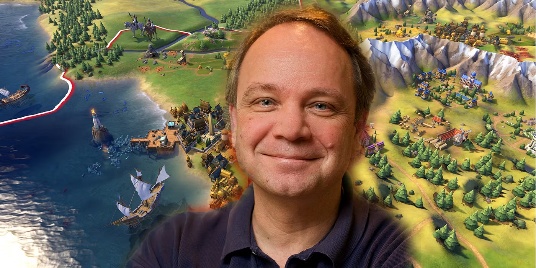
Sid Meier, with whom I worked on a few things, used to try to build 5 sub-systems, each of which was easy to tune and bug test, but when they interlocked, the emergent outcomes were totally unpredictable. “You build systems, not scripts” and “a good game is a series of interesting choices.” And there’s the rub. Trying to figure out what interesting is.

So for example, in Civilization, had very easy to understand diplomacy choices (alliance, declare war) which always led to national competition, and historically interesting tech tree choices (like steam engines) which always led to manufacturing and transportation, but the player could never predict which country would create warships vs factories, railroads vs cities, and who would attack first and where.
That’s how John Madden Football worked in Scott Orr’s design. Every game cycle, all of the players would scan the field multiple times a second, and then depending on their “awareness” rating, they would change direction or not, try to tackle or not. Before “Coach” Madden would ok each year’s game, he’d watch a few minutes to see if the simulated players looked sort of like real players, with varying levels of football sense. But when the ball was hiked, it was fascinating to see whether the running back “hit” the proper hole, whether the linebacker “read” the play correctly, and whether the runner was “stuffed” or “broke ankles.”


There was a similar approach to play-calling. Madden’s Oakland Raider playbook had more than a hundred plays from various formations, with “tendencies” he dictated to us, and then of course, we had to watch actual games to validate. It turned out, for example, that baseball manager Earl Weaver who said, “On my team, the only time you bunt is when you accidentally tap the ball when you’re trying to hit a home run;” but then of course, we as fans found a few exceptions. “Oh that was different….” He answered, admitting that his dictates weren’t actually absolute.

Then we’d run a few games to see if the stats of the players seemed within a credible range compared to their actual season statistics. In other words, if Christian McCaffrey averages 20 runs and 6 pass receptions in an actual NFL season, we’d check that his Madden version would average 15-25 and 4-8, for example. I know, because I actually did some of that math and playtesting.
Design was very labor intensive and play-test intensive. That’s why Blizzard famously ran beta tests of its big games like World of Warcraft for month after month, with millions of players, to get the tuning just right. That was the early 2000’s. By comparison, Dani Bunten Berry, Hall of Fame game designer in the 80’s, ran casual focus groups on MULE and Seven Cities of Gold, which was well beyond the norm at the time.

So where did designers go to discover their real-world precedents? Sid Meier, for his game of Sid Meier’s Sim Golf bought and read every book he could find on golf course design, starting with Robert Trent Jones. John Madden gave us his Raider playbook, but also the syllabus from the college course he taught one year. Will Wright read extensively for Sim City, books like Jane Jaccob’s The Death and Life of American Cities, and, for The Sims, Abraham Maslow’s Motivation and Personality which led to the motives design. Peter Molyneux and Demis Hassabis read extensively about amusement parks and actually took field trips to prep for the wonderful Bullfrog game, Theme Park. 
On the other hand, Peter told me that he based Magic Carpet based on his imaginings as a little boy in England, which sounds similar to Richard Garriott’s approach with Ultima. Richard “Lord British” Garriott who once told me he “just dreamed them up.” And Alex Garden turned to the TV show Battlestar Galactica to think about his space combat game, Homeworld and then tried to make it “more majestic.”


It turns out that LLM’s are extraordinarily good at finding source materials and summarizing them, which could have saved Will and Sid tens or even hundreds of hours at the book store and evenings reading in their favorite easy chairs. I suspect, though, that the act of reading could have been a sort of creative meditation, an immersion, for these noted Hall of Famers, but you’ll have to ask them yourself.
